
Septoplasty, often called deviated septum surgery, is an operation that straightens the wall dividing the two sides of the nose (the septum) to improve breathing. A blocked nose, repeated nosebleeds, snoring or a feeling of pressure in the face may all have a deviated septum behind them. At İstanbul Burun Estetiği, our clinic in Bakırköy, Istanbul, we plan septoplasty either as a functional operation that corrects only the inside of the nose without changing its outer shape, or, when needed, together with cosmetic correction. This page explains what a deviated septum is, its symptoms, how it is diagnosed, how the operation is performed, what recovery looks like and what the risks are.
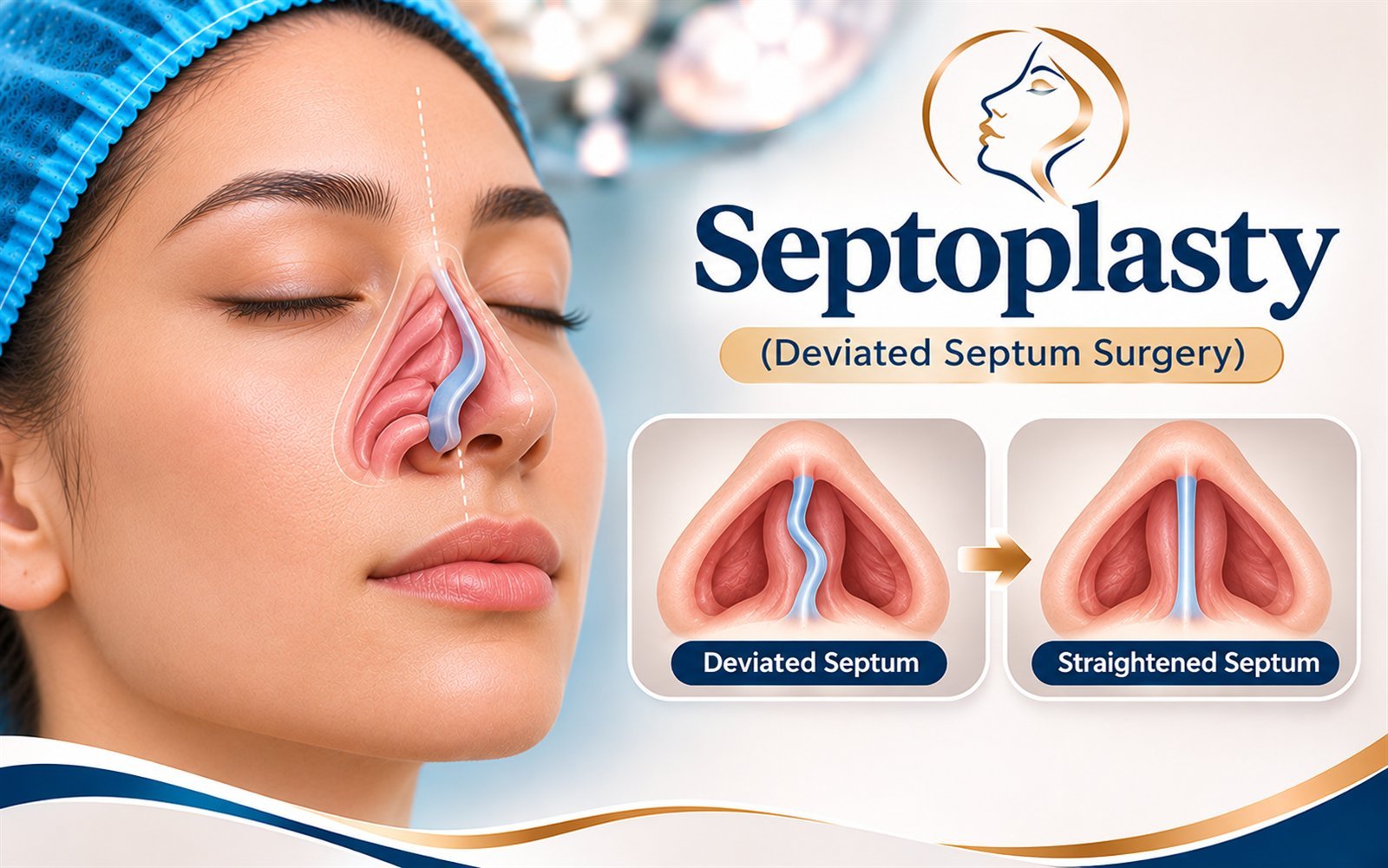
What is the septum and how does a deviated septum develop?
The septum is a thin wall of cartilage and bone that divides the nose into a right and a left side. When this wall bends to one side, the airway on that side narrows and breathing becomes harder.
The septum sits in the middle of the nose, made of cartilage at the front and bone at the back. In the ideal case it is straight and divides the nose into two equal airways. In practice, most people have a septum that is bent to some degree. A slight bend often causes no complaint; a marked bend can restrict airflow on one or both sides.
The main causes of a deviated septum are:
- Congenital and developmental causes: The facial bones and nose grow at different rates, so a septum can be crooked from birth. Pressure on the nose during birth may also play a role.
- Injury: Blows to the nose in childhood or adulthood, sports injuries, falls or accidents can bend or break the septum. Sometimes the injury is not even remembered.
- Previous nose surgery: A new deviation can develop after an earlier operation.
- Connective tissue conditions: Rarely, certain genetic conditions are associated with it.
A deviated septum is not by itself a disease; what matters is whether it causes complaints. Someone with a mild bend and no symptoms may not need an operation.
What are the symptoms of a deviated septum?
Symptoms vary with the position and degree of the bend. The most common are:
- Nasal blockage: Usually on one side, sometimes both; it may switch sides. It becomes worse during allergies or colds.
- Difficulty breathing: Felt more during exercise or at night.
- Snoring and poorer sleep: A blocked nose can lead to mouth breathing and sleep problems. Note: snoring has many causes and cannot be attributed to the septum alone.
- Repeated nosebleeds: Airflow and dryness at the bent area can make the lining bleed easily.
- Nasal and post-nasal discharge: Disturbed airflow can affect mucus drainage.
- Frequent sinusitis: A deviated septum can narrow sinus openings and predispose to sinus infection.
- Facial pressure and headache: In some people, contact points inside the nose can cause facial pain.
- Reduced sense of smell: Air may not reach the smell area well.
- Dry mouth: A result of breathing through the mouth.
Because these symptoms can also come from other conditions, an examination is needed for a correct diagnosis.

How is it diagnosed?
A deviated septum is diagnosed through a careful history and an examination of the nose. At our clinic the assessment generally includes the following steps:
History
When the complaints began, which side is more blocked, any history of injury, allergy, sinusitis, nasal spray use and previous operations are asked about.
Nasal examination
The outside and inside of the nose are examined with light and special instruments. The position and degree of the bend, the state of the turbinates (the folds inside the nose) and the lining are assessed.
Nasal endoscopy
A thin, lighted endoscope allows a deeper look inside the nose. The procedure is brief and done in the clinic. Whether the bend is in the back of the nose, the sinus openings and conditions such as polyps can be assessed this way.
Imaging
When needed, imaging such as a CT scan of the sinuses may be requested. It is especially useful for repeated sinusitis or when planning surgery.
Assessing nasal function
The resistance of the nasal passage to airflow is assessed at examination. The contribution of other causes of blockage, such as allergy or enlarged turbinates, is also investigated, because septal correction alone is sometimes not enough.
Does every deviated septum need surgery?
No. Septoplasty is considered only for a deviated septum that causes complaints which medical treatment cannot control. The points assessed before surgery are:
- Has medical treatment been tried? Conditions such as allergic rhinitis, enlarged turbinates or swollen lining can be controlled with nasal sprays, antihistamines and saline rinses. A structural bend does not improve with medicine, but these treatments can ease blockage.
- How much do the complaints affect quality of life? The effect on sleep, exercise, work and daily comfort is assessed.
- Severity and position of the bend: Bends at the front of the nose usually cause more marked complaints.
- Accompanying conditions: Turbinate enlargement, sinusitis, polyps and allergy affect the surgical plan.
At the consultation our doctor assesses with you whether septoplasty is truly needed and whether medical treatment would be enough.
How is septoplasty performed?
Septoplasty is carried out entirely through the nose, with no external incision. The details vary from person to person; the summary below is a general framework.
1. Anaesthesia
Septoplasty is usually done under general anaesthesia; in selected cases sedation with local anaesthesia may be considered. The type is planned with the anaesthetist according to your health history and the extent of surgery.
2. Incision and exposing the septum
A small incision is made inside one nostril, in a place that cannot be seen from outside. The thin lining covering the septum is separated from the cartilage and bone.
3. Correcting the bent parts
The bent cartilage and bone are straightened. Part of the septum may be removed, reshaped or repositioned. A sufficient L-shaped strip of cartilage is always left to support the tip and bridge; this support is very important so that the shape of the nose is not altered.
4. Additional procedures if needed
If enlarged turbinates accompany the bend, a turbinate reduction (turbinoplasty) can be done in the same operation, which helps relieve blockage completely. When sinus problems are present, additional procedures are planned separately.
5. Closure and support
The lining is laid back in place and the incision closed with dissolvable stitches. Soft silicone splints or packing may be placed inside the nose to help the lining stick to the septum and prevent blood collecting. These are usually removed within a few days.
Septoplasty commonly takes about 30 to 90 minutes; additional procedures may lengthen it. Because no external incision or splint is needed, the outer appearance does not change noticeably after septoplasty alone.
Recovery after septoplasty
Recovery after septoplasty is generally quicker than after rhinoplasty because the outside of the nose is not changed. The timeline below is a general framework; our doctor's instructions always take priority.
| Period | Commonly seen | General advice |
|---|---|---|
| First 24–48 hours | Nasal blockage, slightly bloody discharge, a feeling of fullness in the face | Keep your head raised, rest, take the medicines advised |
| Days 3–7 | Swelling inside the nose, crusting, splints or packing | Splints are usually removed now; do not blow your nose |
| Weeks 1–2 | Blockage gradually eases, crusting may continue | Saline nasal care, light daily activity |
| Weeks 3–6 | Breathing becomes noticeably easier | Avoid heavy exercise and activities with a risk of knocks to the nose |
| Months 3–6 | Healing inside the nose is completed | Check-up if needed |
What to expect in the first days
After surgery you can expect a blocked feeling, slightly bloody discharge from the nose and fullness in the face, caused by swelling of the lining inside the nose and by the splints or packing. You may need to breathe through your mouth for the first days; this is temporary. Pain is usually mild and managed with the painkillers advised.
Nose care
Cleaning the nose regularly with saline or solutions advised by our doctor reduces crusting and speeds healing. Blowing the nose is forbidden for the first weeks because it can damage the newly closed lining and cause bleeding. If you need to sneeze, keep your mouth open.
Returning to daily life
For desk work most people return within a few days to a week. Heavy exercise, swimming, heavy lifting and activities with a risk of knocks to the nose are avoided for a few weeks. The timing of flying should be agreed with our doctor.
When to seek help immediately
Contact the clinic or an emergency service without delay for uncontrolled bleeding, high fever, severe and increasing pain, shortness of breath, changes in vision, or redness and pus around the nose.
Risks and possible complications
Septoplasty is generally a safe operation, but like any surgery it has risks, and they should be discussed openly before surgery.
- Bleeding: Bleeding inside the nose can occur after surgery. It is usually mild; rarely, further treatment is needed.
- Haematoma (blood collection under the lining): Rare; if not recognised and drained early it can lead to complications.
- Infection: Rare; managed with antibiotics and nose care.
- Septal perforation (a hole in the septum): A small hole in the lining; often causes no complaint but in some people can cause whistling, crusting or bleeding.
- Blockage persisting or returning: Enlarged turbinates, allergy or the septum bending again over time can leave complaints.
- Change in the shape of the nose: If too little support is left, the bridge can sink or the tip can drop (rare).
- Temporary or lasting change in the sense of smell: Very rare.
- Temporary numbness of the upper teeth and palate: Can occur when septal nerves are affected; usually temporary.
- Need for revision: Rarely, an additional correction is needed.
These risks are assessed individually at the consultation. Smoking, bleeding disorders and some medicines can affect them, so sharing your full health history is very important.
Turbinates, allergy and septoplasty
Nasal blockage does not always come only from a deviated septum. Inside the nose there are folded structures called turbinates, which humidify and warm the air. Allergy, chronic irritation or a deviated septum can make them enlarge (turbinate hypertrophy) and worsen blockage. It is therefore important to find out how much of a person's breathing complaint is due to the septum and how much to the turbinates or allergy.
At examination the size, colour and response to medicine of the turbinates are assessed. If enlargement does not respond to treatment and clearly contributes to blockage, a turbinate reduction can be planned together with septoplasty. This aims to reduce volume while preserving tissue. Removing turbinates completely is not recommended because excessive tissue loss can lead to long-term problems such as “empty nose syndrome”, so turbinate procedures should always be conservative and measured.
In people with allergy, allergy treatment should continue after septoplasty. Otherwise swelling of the lining can keep the nose blocked even after the operation. Supportive treatment such as nasal sprays, antihistamines and nasal rinses is therefore continued on our doctor's advice.
Septal deviation in children and teenagers
A deviated septum can also occur in children. However, because the nose and face are still growing, septoplasty is generally postponed until growth is complete. The growth centres of the nose are closely related to the septal cartilage, and early, extensive surgery could affect the development of the nose. For this reason, in children and teenagers the decision to operate is made very carefully, taking into account the severity of the complaint and its effect on quality of life.
In mild cases medical treatment and observation are preferred. If there is a serious breathing problem, repeated sinusitis or a sleep disorder, a limited and conservative septal correction may be considered. These decisions are individual and, when needed, a detailed discussion with the child and parents is held.
Long-term results and follow-up
The results of septoplasty settle as the tissues inside the nose heal. Most people feel a clear easing of breathing in the first weeks, but the full result cannot be seen until swelling of the lining and tissue has gone down completely. Crusting and dryness inside the nose may last a few weeks. Regular nose care and check-ups matter during this period.
In the long term, the purpose of septoplasty is to keep the airway open anatomically. The operation does not remove accompanying conditions such as allergy, sinusitis or turbinate enlargement; their treatment continues separately. Most patients report clear satisfaction, but it should be understood that no result can be guaranteed, that complaints may rarely continue in part, or that a further correction may be needed.
After surgery, being careful in activities with a risk of knocks to the nose helps prevent the septum bending again. If you notice a new or persisting breathing problem within a year or afterwards, you can come to us for an examination.
Septoplasty and rhinoplasty: differences and combining them
Septoplasty corrects the inside of the nose and is a functional operation. Rhinoplasty aims to change the outer appearance of the nose. The two can be done independently of each other, and in some people they are done together in the same operation.
| Feature | Septoplasty | Rhinoplasty |
|---|---|---|
| Aim | Improve breathing function | Change the appearance and/or function of the nose |
| Incision | Inside the nose only | Inside the nose ± columella (open technique) |
| Outer appearance | Not noticeably changed | Changed as planned |
| Splint | Usually none; internal splints may be used | External splint is used |
| Recovery | Usually quicker | Swelling and final shape can take months |
If a cosmetic concern accompanies the deviated septum, both procedures can be done in the same operation, which is called septorhinoplasty. See our septorhinoplasty page for details.
Preparing for septoplasty
Good preparation supports safety and healing. The general advice is:
- Examination and tests: Nasal examination, endoscopy and imaging if needed. Blood tests and similar checks are requested for anaesthetic safety.
- Medicines: Some medicines and supplements that may increase bleeding must be stopped before surgery. Always ask your doctor which medicine to stop and when; do not stop medicines on your own.
- Smoking and nicotine: Stopping for a period before and after surgery is recommended.
- Fasting: Fasting instructions before anaesthesia must be followed.
- Accompanying person: You need someone with you on the day of surgery and help at home in the first days.
- Questions and expectations: Discuss your expectations and worries openly with your doctor.
Common misunderstandings about septoplasty
“Septoplasty changes the look of the nose.”
Septoplasty is an internal operation and does not noticeably change the outer appearance. If a cosmetic change is wanted, rhinoplasty or septorhinoplasty is planned.
“The nose opens up straight after septoplasty.”
In the first days swelling and splints can make the nose feel more blocked. Breathing becomes noticeably easier over weeks as swelling goes down and the inside of the nose heals.
“Septoplasty cures all blockage.”
Septoplasty targets blockage caused by a deviated septum. If allergy, enlarged turbinates or polyps are also present they are handled separately; otherwise complaints may continue.
“The operation is very painful.”
Most people complain more of blockage and fullness than of pain after surgery. Pain is usually mild to moderate and can be managed with painkillers.
“Once septoplasty is done, the septum never bends again.”
Rarely, the septum can bend again over time or be disturbed by a new injury, so a result cannot be guaranteed.
What affects the cost of septoplasty?
The cost of septoplasty is not one fixed number. The severity of the deviation, additional procedures (such as turbinate reduction), the type and length of anaesthesia, hospital and theatre conditions, and post-operative check-ups all affect the price. When performed for a medical reason, septoplasty may fall within the cover of some insurers; this depends on the policy and the insurer, so we suggest checking with them beforehand. Because we cannot state a fair amount without an examination, we do not publish a figure here; the exact amount is set in a written quote after your consultation with us. See our cost page for more.
Septoplasty at our clinic
İstanbul Burun Estetiği is a rhinoplasty clinic in Yalı Ataköy, Bakırköy, Istanbul. Our septoplasty process has four stages:
- Consultation: Your complaints, health history and nasal structure are assessed together with our doctor; endoscopy is done when needed.
- Planning: Whether surgery is needed, the risks and the alternatives are shared with you, and needed tests are requested.
- Surgery: The planned procedure is carried out under suitable anaesthetic conditions.
- Follow-up: Splints or packing are removed at the clinic, followed by planned check-ups.
Frequently asked questions about septoplasty
An operation that straightens a bent septum to improve breathing. It is also known as deviated septum surgery.
No. Septoplasty is an internal procedure and does not noticeably change the outer appearance. If a cosmetic change is wanted, rhinoplasty or septorhinoplasty is planned.
You feel no pain during the operation because it is done under anaesthesia. In the following days most people have mild to moderate discomfort and a blocked feeling; it can be managed with painkillers.
Septoplasty commonly takes about 30 to 90 minutes. Additional procedures can lengthen it.
When needed, soft silicone splints or packing are placed inside the nose. They are usually removed at the clinic within a few days.
For desk work most people return within a few days to a week; physical jobs may take longer. This depends on our doctor's assessment.
Heavy exercise and sports with a risk of knocks to the nose are usually avoided for several weeks. Gentle walking may be possible earlier with our doctor's approval.
Swelling can keep the nose blocked in the first days. Breathing becomes noticeably easier over weeks, and healing inside the nose is completed over months.
Septoplasty done for a medical reason may fall within the cover of some insurers. This depends on the insurer and the policy, so we suggest checking with them.
Yes. If there is both a deviated septum and a cosmetic concern, the two can be done in the same operation, which is called septorhinoplasty.
Septoplasty is generally done after growth is complete. In children and teenagers surgery is considered carefully so that facial growth is not affected.
Reach us by phone, WhatsApp or email to arrange a consultation. Our clinic is in Yalı Ataköy, Bakırköy, Istanbul.