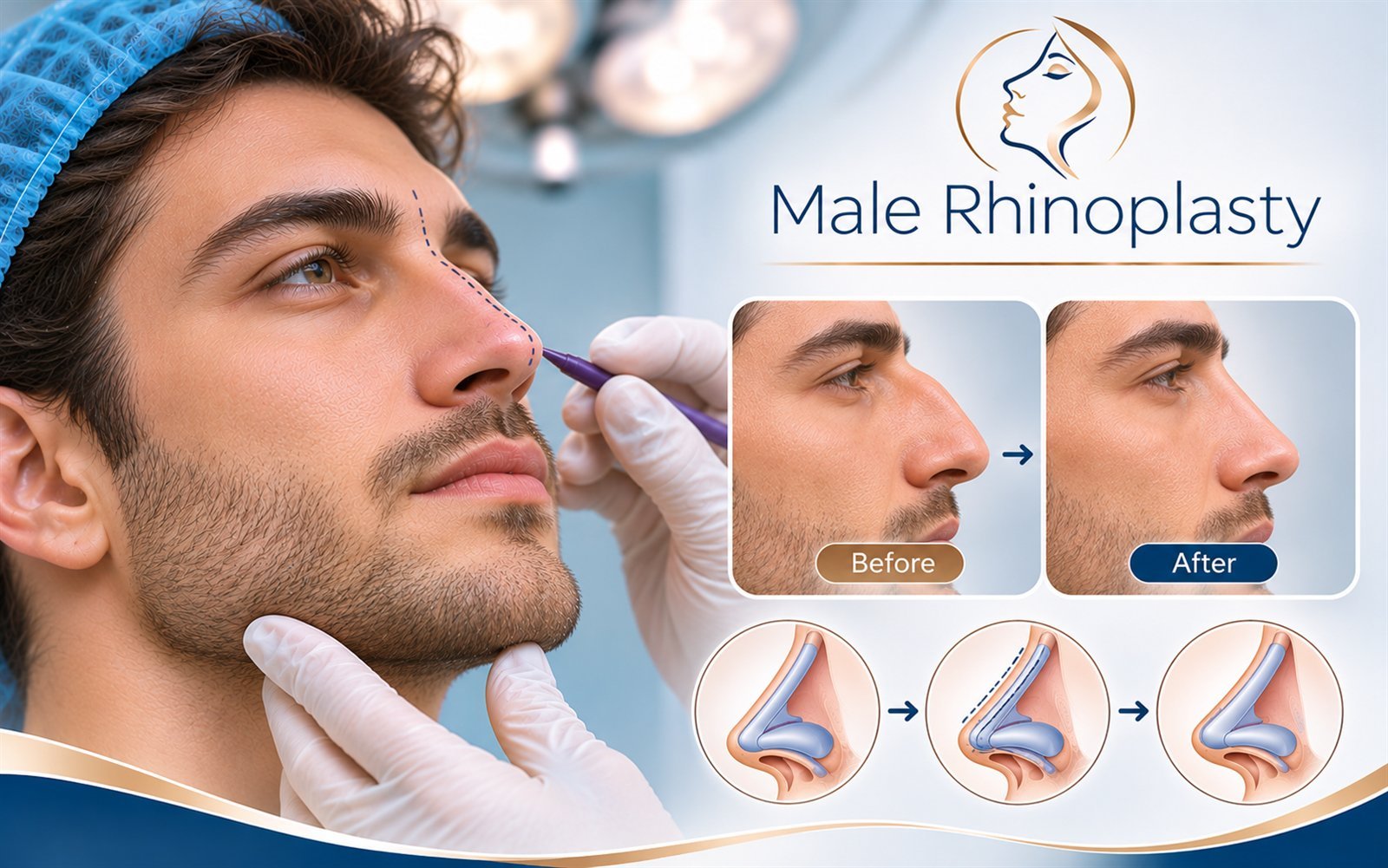
Male rhinoplasty is rhinoplasty planned around the male facial structure, the anatomy of the male nose and the expectations of men. The aim is not to make the nose as small or as “soft” as possible; it is to correct the area that bothers the patient, and improve breathing where needed, while keeping a strong, straight line that suits the face. At İstanbul Burun Estetiği, our clinic in Bakırköy, Istanbul, we plan nose surgery for men with the aim of a natural result that keeps a masculine look and is not noticeable as surgery. This page explains the features of the male nose, common complaints, what is considered in planning, the operation, recovery and returning to daily life.
What is male rhinoplasty?
Male rhinoplasty is rhinoplasty planned to suit the male face. The goal is to solve the problem while keeping the firm, straight line of the bridge, the natural set of the tip and the proportions of the face, avoiding a “feminine” or “operated” look.
Rhinoplasty is surgery that changes the shape, size or breathing function of the nose. Technically the same surgical principles apply to women and men, but the anatomy of the nose, facial proportions, skin structure and aesthetic goals can differ with sex. In male rhinoplasty these differences are taken into account in planning.
In men, the decision to operate usually comes up for two reasons. The first is dissatisfaction with the shape of the nose, such as a marked bump on the bridge, a wide or drooping tip or a crooked nose. The second is functional: a nose distorted by sports injury, accident or a blow, a deviated septum and the breathing difficulty that comes with it. In many men both reasons are present, and cosmetic and functional correction are then planned together.

Anatomical and aesthetic features of the male nose
When an operation is planned, the general features of the male nose are kept in mind. They vary from person to person and are general tendencies, not rules; each face is assessed with its own proportions.
- The bridge: In the male face the bridge is usually straighter, stronger and more defined. Lowering the bridge too much or giving it a curve can look out of keeping with the firmness of the face.
- The root of the nose: The area where the forehead meets the nose is generally higher and more prominent in men, which gives the face a strong profile.
- Angle of the tip: The upward rotation of the tip is generally more limited in men. Lifting the tip too far can lead to an operated look that does not suit the face.
- Width of the nose and nostril wings: The male nose is often somewhat broader and more strongly built. Harmony between the width of the nose and the width of the face matters; narrowing too much spoils naturalness.
- Skin structure: Male skin may on average be thicker and oilier than female skin. This can make swelling go down more slowly and limit how much the tip can be refined. See our thick-skinned noses page for details.
- Facial lines: Features such as a defined chin, a strong brow line and broad facial lines are assessed together with the proportions of the nose.
For this reason the aim in male rhinoplasty is not to apply a “standard template” but to reach a result that suits the person's own facial structure and keeps his own character.
Common nose complaints in men
The complaints men most often bring to the consultation are:
A bump on the bridge
A bump on the bridge seen in profile is one of the most common reasons male patients come. Removing the bump completely is often not necessary; a strong, straight line that suits facial proportions is the aim. See our dorsal hump reduction page for details.
A crooked nose and deformity after injury
Sports injuries (football, boxing, martial arts, basketball and so on), falls and accidents can bend or break the nasal bones and septum. This affects both appearance and breathing. In these cases cosmetic and functional correction are often planned together.
Deviated septum and difficulty breathing
Because a history of injury is more common in men, a deviated septum and the nasal blockage that goes with it are also common. Septoplasty or septorhinoplasty then comes up. See our septoplasty and septorhinoplasty pages for details.
A wide, drooping or thick tip
A wide, bulbous or drooping tip is a common complaint, especially in men with thick skin. Tip correction should be done without spoiling the natural set of the tip. See our nasal tip rhinoplasty page for details.
A nose that has been operated on before
Male patients who were not satisfied with a first operation, or who developed breathing problems after it, can come for a revision assessment. See our revision rhinoplasty page for details.
Nose size and disharmony with the face
The nose being seen as large relative to other parts of the face is also a common complaint. In that case it is usually necessary to assess the root, bridge, tip and chin proportions together, not simply to make the nose smaller.
Basic principles of planning in male rhinoplasty
A successful result in male patients is planned with the following principles:
1. Preserving masculine lines
The strong bridge line of the male face, the natural set of the tip and the balance of facial proportions are preserved. Lowering the bridge too far, lifting the tip too far or narrowing the nose more than needed can lead to a “feminine” or “artificial” look, so measured and controlled corrections are preferred.
2. Aiming for an “unnoticeable” result
Many male patients do not want the result to be noticed by others as “having had a nose job”. The goal is therefore set not as a dramatic change but as a natural-looking improvement that suits the face. See our natural-looking rhinoplasty page for details.
3. Protecting and improving breathing
In men who play sport or work in physical jobs, breathing capacity is especially important. While cosmetic corrections are made, the nasal valves and septum are protected and, when needed, improved.
4. Taking skin thickness into account
In thick skin, refining the tip may be limited and swelling lasts longer. Goals are set realistically accordingly.
5. Assessing the facial profile as a whole
The nose is considered together with the forehead, chin and lip proportions. In some cases the nose looks larger because of a receding chin, and this is discussed openly at the consultation.
How is male rhinoplasty planned and performed?
The details vary from person to person. The summary below is a general framework; your personal plan is set by our doctor at the consultation.
1. Consultation and photographs
The nose and face are examined from several angles and photographed. Your expectations, health history, sport and injury history and breathing are assessed.
2. Choice of technique
The open or closed technique is chosen according to the structure of the nose and the planned correction. If bone work is needed, options such as the piezo device may also be considered. See our open rhinoplasty, closed rhinoplasty and piezo rhinoplasty pages for details.
3. Anaesthesia and surgery
The operation is usually done under general anaesthesia. The planned corrections (bridge, tip, bony structure, septum) are carried out according to the goal. When needed, cartilage grafts are used to support the nose.
4. Splint and the first days
An external splint is placed over the nose and, when needed, supports are placed inside. The splint is usually removed around the first week at our clinic.
The length of surgery varies with its extent; a primary rhinoplasty commonly takes about two to four hours. Cases needing septal correction, grafts or revision may take longer.
Recovery after male rhinoplasty
Recovery is similar to that of rhinoplasty in general. The timeline below is a general framework; our doctor's instructions always take priority. For more detail, see our recovery page.
| Period | Commonly seen | General advice |
|---|---|---|
| First 24–48 hours | Nasal blockage, slightly bloody discharge, swelling | Keep your head raised, rest, take the medicines advised |
| Week 1 | Bruising, splint, stitches | Splint is usually removed now; do not blow your nose |
| Weeks 2–3 | Bruising fades noticeably, swelling continues | Light daily activities are usually possible |
| Weeks 4–6 | Most swelling settles | Avoid heavy exercise and activities that put pressure on the nose |
| Months 3–6 | Tip swelling slowly goes down (can take longer in thick skin) | Continue check-ups |
| Month 12 onward | Final shape settles | Long-term follow-up |
Sport and exercise
For male patients who play sport, the most common question is when they can return. Heavy exercise, weightlifting and sports with a risk of knocks to the nose (contact sports, team sports, martial arts) are usually avoided for several weeks. Gentle walking may be possible earlier with our doctor's approval. Returning to contact sports usually needs a longer wait and is planned together with our doctor. Protecting the nose during sport matters, especially in the first months.
Returning to work
For desk work most people return in about 1–2 weeks; physical jobs may take longer. Because of the splint and bruising, it may be necessary to plan for the first two weeks in terms of appearance in social life. This depends on our doctor's assessment.
Shaving, glasses and daily care
- Shaving: The upper lip area can be sensitive in the first weeks because of numbness at the tip. Follow our doctor's advice on when and how to shave.
- Glasses: Glasses can press on the bridge, so for several weeks special supports or alternatives are used as our doctor advises.
- Sun protection: Nasal skin can stay sensitive for a long time; avoid sunburn.
- Smoking and alcohol: They can slow healing; follow our doctor's instructions.
When to seek help immediately
Contact the clinic or an emergency service without delay for uncontrolled bleeding, high fever, severe and increasing pain, shortness of breath, or redness and pus around the nose.
Nose, chin and facial proportions: assessing the male face as a whole
In the male face the nose, chin line and forehead together define the “character” of the face. Sometimes a nose looks large not because of the nose itself but because of a receding chin or a flat forehead. In such cases, simply making the nose smaller can upset the overall balance of the face. The facial profile is therefore examined as a whole at the consultation; the relationship of nose, lips, chin and forehead is assessed together.
When necessary, other structures such as the chin profile are also discussed alongside the nose, but these decisions are always made together according to the patient's wishes and the doctor's assessment. The aim is to adopt an approach that brings the whole face, not a single area, into harmony. That way the nose sits naturally as part of the face and the operation is perceived as an improvement that is “not noticeable from the outside”.
Practical guide for the day of surgery and the first days
Planning the day of surgery and what follows in advance makes the process easier. The tips below are general information.
- Day of surgery: Arrive fasting as instructed for anaesthesia, wear comfortable front-opening clothes and have someone accompany you. Do not use contact lenses, jewellery or make-up.
- Going home: Do not drive yourself after surgery. Have someone with you the first night.
- First 48 hours: Rest with your head raised and take your medicines regularly. Nasal blockage and slight oozing are expected.
- Food and fluids: Start with light, soft foods and drink plenty of fluids. Avoid very hot and spicy food.
- Sleep: Sleep on your back with your head raised; do not sleep on your front.
- Phones and screens: Avoid looking down at a screen for long periods.
- Contact: If something worries you, contact the clinic; call emergency services for emergency symptoms.
The first two weeks matter for arranging your social plans and work accordingly. Most male patients find returning to daily life easier after the splint is removed.
Risks of male rhinoplasty
As with any surgery, rhinoplasty has risks. They should be discussed openly before the operation.
- Bleeding, bruising and infection,
- Complications related to anaesthesia,
- Persisting or new difficulty breathing,
- Asymmetry or not achieving the intended shape,
- Changes in shape over time at the bridge or tip,
- In thick skin, swelling that lasts long and limited refinement of the tip,
- Temporary numbness at the tip and around the upper lip,
- An “artificial” or disharmonious look as a result of over-correction,
- The need for revision surgery.
These risks are assessed individually at the consultation. Smoking, certain medicines and chronic conditions can affect them, so sharing your full health history is very important.
Common misunderstandings about male rhinoplasty
“Rhinoplasty in a man always means making the nose smaller.”
The goal is often not to make the nose smaller but to bring it into harmony with the face. A nose that has been made too small can look out of keeping on a male face.
“My nose will look feminine after surgery.”
This risk is lower when planning respects masculine lines. The problem usually comes from unmeasured corrections such as a bridge lowered too far, a tip lifted too far or too much narrowing.
“Recovery is faster for men.”
Recovery depends on skin structure, age, general health and the extent of surgery more than on sex. In men with thick skin, swelling can last longer.
“I play sport, so I will be back quickly.”
Healing of nasal bone and cartilage takes time. Returning early carries the risk of knocks or pressure and can spoil the result. The time to return should be decided together with your doctor.
“Everyone will know I had a nose job.”
With natural-looking planning and measured correction, the result can often suit the face without giving an impression of “having had nose surgery”, but no result can be guaranteed.
Consultation and preparation
At our clinic the first meeting covers the following:
- Your expectations: It is important to explain what you want to change, what you want to keep and whether you want an “unnoticeable” result.
- Health, sport and injury history: Previous operations, medicines, allergies, bleeding disorders, sports injuries and blows to the nose must be shared.
- Nasal examination: The structure of the nose, skin thickness, septum, nasal valves and breathing function are assessed; endoscopy is done when needed.
- Photographs: The face and nose are photographed from different angles and goals are discussed with them.
- Tests: Blood tests and similar checks are requested for anaesthetic safety.
Before surgery
- Smoking and nicotine products should be stopped for a period before and after surgery.
- Some medicines, protein and vitamin supplements that may increase bleeding must be stopped under medical supervision before surgery.
- Fasting instructions before anaesthesia must be followed.
- You need someone with you on the day of surgery and help at home in the first days.
- Arrange your work and sport programme in advance for the recovery period.
What you need to know before deciding
Deciding on nose surgery is a decision that should not be rushed and should be made with good information. Writing down your goals, health history and questions before you come to the consultation makes the meeting more productive. Knowing that surgery is not a promise of perfection, that recovery takes time and that the result varies from person to person helps keep expectations realistic.
At our clinic we do not pressure you to decide. During the consultation we explain openly the reasons for the recommended plan, its alternatives and its possible risks, answer your questions and give you time to decide. Getting a second opinion is also perfectly legitimate. You can reach us by phone, WhatsApp or email to arrange a consultation.
What affects the cost of male rhinoplasty?
The cost of male rhinoplasty is not one fixed number. The extent of surgery, additional procedures such as septal correction, the open or closed technique, the need for grafts, extra work related to skin thickness, the type and length of anaesthesia, hospital and theatre conditions, and post-operative check-ups all affect the price. Because we cannot state a fair amount without an examination, we do not publish a figure here; the exact amount is set in a written quote after your consultation with us. We put in writing what the quote includes and excludes. See our cost page for more.
Male rhinoplasty at our clinic
İstanbul Burun Estetiği is a rhinoplasty clinic in Yalı Ataköy, Bakırköy, Istanbul. Our process has four stages:
- Consultation: Your expectations, health and injury history and nasal structure are assessed together with our doctor.
- Planning: A plan that preserves masculine lines, the technique, risks and alternatives are shared with you, and needed tests are requested.
- Surgery: The planned procedure is carried out under suitable anaesthetic conditions.
- Follow-up: The splint and stitches are removed at the clinic, followed by planned long-term check-ups.
For patients travelling from outside Istanbul or from abroad, accommodation, the length of stay for the first check-up and follow-up arrangements after returning home should be planned in advance.
Frequently asked questions about male rhinoplasty
The surgical principles are the same, but because nasal anatomy, facial proportions, skin structure and aesthetic goals can differ, the plan is made to suit the male face. Preserving masculine lines is a basic principle.
This risk is lower with measured planning that respects masculine lines. Unmeasured corrections such as a bridge lowered too far, a tip lifted too far or too much narrowing can lead to a disharmonious look.
Yes. A crooked nasal bone and septum can be dealt with by combined cosmetic and functional correction. The suitable method is decided at the consultation.
A primary rhinoplasty commonly takes about two to four hours. Cases needing septal correction, grafts or revision may take longer.
You feel no pain during the operation because it is done under anaesthesia. In the following days most people report mild to moderate discomfort that can be managed with painkillers.
Heavy exercise and sports with a risk of knocks to the nose are usually avoided for several weeks. Returning to contact sports can take longer; timing is decided together with our doctor.
For desk work most people return in about 1–2 weeks; physical jobs may take longer. This depends on our doctor's assessment.
In thick skin, refining the tip may be limited and swelling lasts longer. Goals are set realistically. See our thick-skinned noses page for details.
No. Most swelling settles in the first weeks, but the final shape often takes 12 months or longer.
It can both improve and worsen breathing. Nasal function should be assessed before surgery and included in the plan.
Reach us by phone, WhatsApp or email to arrange a consultation. Our clinic is in Yalı Ataköy, Bakırköy, Istanbul.