
A saddle nose is a condition in which the middle part of the nasal bridge collapses, leaving a dip in profile in the shape of a saddle. It usually results from loss of cartilage and bone support in the nasal framework, and it can affect not only appearance but also breathing. At İstanbul Burun Estetiği, our clinic in Bakırköy, Istanbul, we assess saddle nose correction within an individual plan that aims to investigate the cause, rebuild the lost support with cartilage grafts, and protect or improve the function of the nose. This page explains the causes and symptoms of a saddle nose, the correction methods, the graft sources used, the risks and recovery.
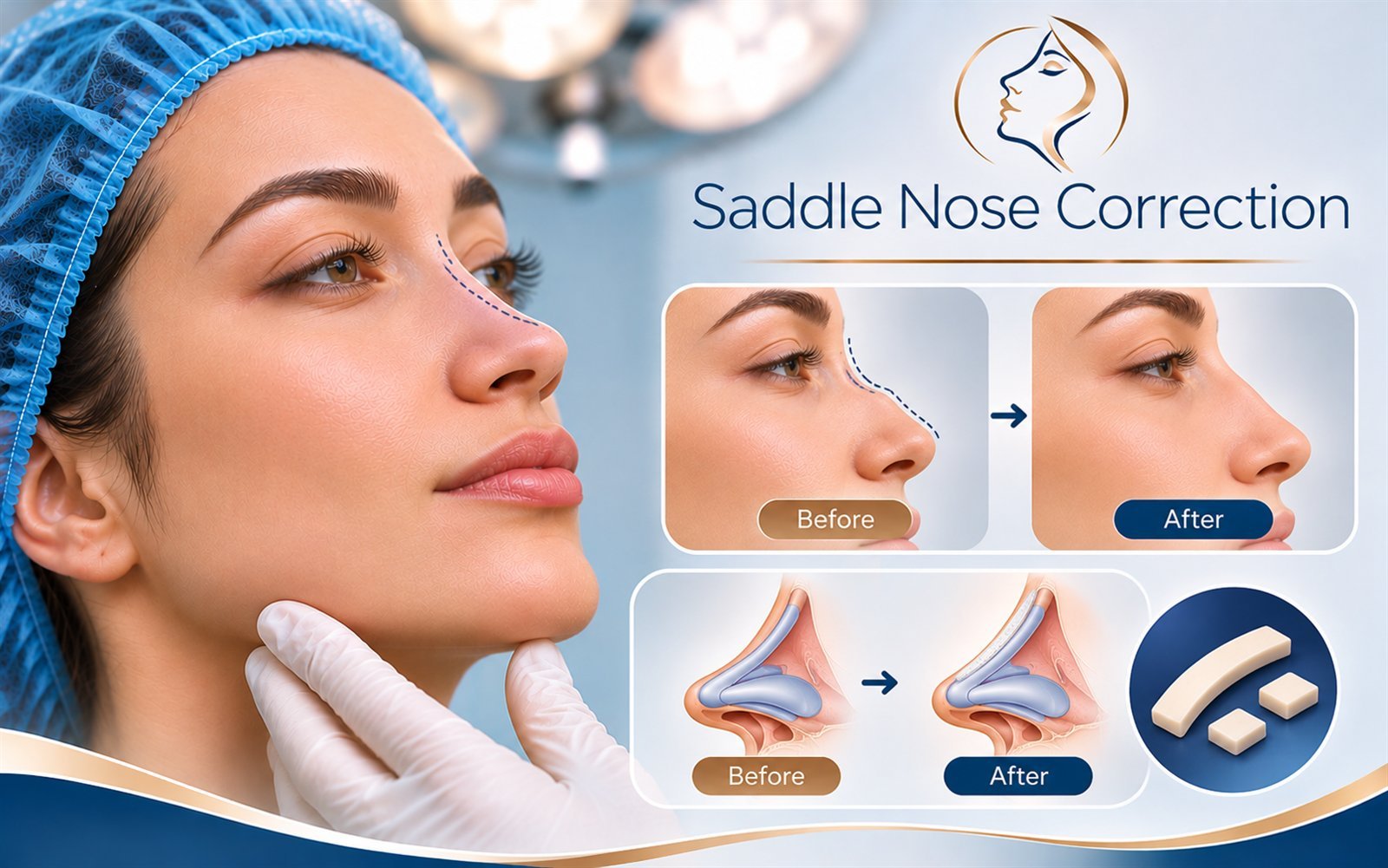
What is a saddle nose?
A saddle nose is a deformity in which the nasal bridge has collapsed and left a dip in profile. It appears when the support of the nasal framework is lost. Correction needs reconstructive rhinoplasty that aims to rebuild the lost support with grafts.
The nasal bridge is supported by the framework formed by the nasal bones, the septum and the upper lateral cartilages. If the middle part of this framework, particularly the cartilage at the front of the septum, collapses, the bridge sinks inward and a dip is seen in profile; because this looks like the shape of a saddle, it is called a “saddle nose”.
A saddle nose can range from mild to severe. In mild cases there may only be a slight hollow on the bridge. In severe cases the bridge can be markedly collapsed, the tip can be left without support and droop, the nose can become short and the nostrils can face forward. The treatment plan is therefore set according to the degree of collapse and the amount of structural loss.

What causes a saddle nose?
A saddle nose has many possible causes. Identifying the cause matters for correct correction.
- Injury: A severe blow to the nose that fractures the septum and nasal bones or collapses the nasal framework is one of the most common causes.
- Septal haematoma or abscess: A collection of blood or pus in the septum (especially if untreated) disturbs the lining that feeds the septal cartilage and can cause the cartilage to dissolve and the bridge to collapse. Swelling and pain in the septum should therefore be treated as an urgent warning sign.
- Previous nose surgery: Removing too much cartilage or bone from the septum and bridge during rhinoplasty or septoplasty can weaken the framework and cause it to collapse over time. This is the most common cause of “iatrogenic” (surgery-related) saddle nose. For information on revision, see our revision rhinoplasty page.
- Use of substances through the nose: Long-term use of certain substances taken through the nose can damage and perforate the septal tissue and cause collapse.
- Inflammatory and autoimmune diseases: Some systemic conditions, such as granulomatous diseases (for example granulomatosis with polyangiitis), relapsing polychondritis and sarcoidosis, can involve cartilage and lining and cause the nasal framework to collapse.
- Infections: Some chronic infections (such as syphilis, tuberculosis and leprosy) can rarely involve the nasal framework.
- Congenital and developmental causes: Rarely, developmental anomalies of the nose are associated with a sunken bridge.
Because some of these causes can be a sign of systemic disease, further tests may be requested when the cause of collapse is unclear. Surgical planning is done when the disease is inactive and under control.
What are the symptoms of a saddle nose?
The symptoms of a saddle nose vary with the degree of collapse and the size of the structural loss:
- A dip in profile: Collapse of the middle of the bridge; a concave look when seen from the side.
- Drooping or upturning of the tip: Because support is lost, the tip can droop, or can look over-rotated (the nostrils face forward).
- Shortening of the nose: In severe cases the length of the nose looks shortened.
- Difficulty breathing: Narrowing of the airway because of collapse of the nasal valve or loss of the septum.
- A hole in the septum: In some cases there is a perforation in the septum; whistling, crusting inside the nose and bleeding can occur.
- Collapse of the nostril wings: The nostrils collapsing inward when breathing in.
- Cosmetic and psychological effect: In many people, dissatisfaction with facial appearance and loss of confidence.
These symptoms show how much the nasal structure has been damaged; however, an examination is needed for a definite assessment.
Diagnosis and assessment
A saddle nose is diagnosed through a detailed history and an examination of the nose. At our clinic the assessment consists of the following steps:
History
When the collapse began, any history of injury, previous nose operations, use of substances through the nose, systemic diseases and medicine use are asked about. Previous operation reports and photographs make assessment easier.
Nasal examination and endoscopy
The outside and inside of the nose are examined carefully. The state of the septum, whether there is a perforation, the health of the lining, the state of the nasal valves and the remaining cartilage support are assessed. Nasal endoscopy helps with this assessment.
Imaging and laboratory tests
When needed, a CT scan of the nose and sinuses assesses the state of bone and cartilage. If a systemic disease is suspected, further tests may be requested together with the relevant specialists.
Functional assessment
Breathing function is assessed by examination, because the aim in correcting a saddle nose is to improve not only appearance but also breathing.
Photographs
The face and nose are photographed from different angles and goals are discussed with them.
How is a saddle nose corrected?
Saddle nose correction is based on rebuilding the lost framework support. It is not enough simply to “fill” the collapsed bridge; a solid structure that also supports the tip, the valves and the septum is needed. The plan varies with the degree of collapse.
In mild collapse
In mild cases the height of the bridge can be restored with thin cartilage grafts placed on the bridge (onlay grafts) or with crushed or diced cartilage used within a layer of tissue (fascia). This approach aims to give the bridge a natural, smooth line.
In moderate collapse
In moderate cases, in addition to collapse there can be loss of tip support and nasal valve problems. In that case, besides grafts on the bridge, spreader grafts open the nasal valves and columellar strut grafts support the tip. If the septum is missing, septal cartilage can be rebuilt.
In severe collapse
In severe cases the nasal framework can be largely lost. Using a broad and strong source such as rib cartilage, the nasal structure can be rebuilt with an L-shaped strut and a dorsal graft. In these cases the skin of the nose may also be shortened, so extra tissue may be needed; surgery is much more extensive and can sometimes be planned in stages (two stages).
Surgical approach and technique
In saddle nose correction, direct access to the nasal framework is generally thought necessary, so the open technique is chosen in most cases. See our open rhinoplasty page for details.
Repairing the septum and breathing function
If there is septal deviation, perforation or valve collapse, breathing function is corrected in the same operation. See our septorhinoplasty page for information on septal surgery.
Graft sources: where does cartilage come from?
The need for grafts is often high in saddle nose correction. The source is chosen according to the amount needed and the state of the structure:
| Source | General characteristics | Points to note |
|---|---|---|
| Septal cartilage | In the same operative field; may be enough for small collapse | In a saddle nose the septum is often reduced or damaged |
| Ear cartilage | Its gently curved shape suits the bridge and tip | The amount is limited; an extra incision is needed |
| Rib cartilage | Gives plenty of strong cartilage; often chosen in moderate and severe collapse | An extra chest incision and pain are possible; a lung-lining complication is rarely seen |
| Fascia (connective tissue) | Can be used to wrap cartilage fragments and smooth the bridge | May need to be taken from an additional site (for example the temple) |
Rib cartilage is an important option in large structural losses, but it means an additional operative site. The choice of graft is discussed at the consultation and the advantages and risks of each source are explained openly.
Can fillers correct a saddle nose?
For mild dips on the bridge, some people may consider non-surgical methods (such as hyaluronic acid filler). In selected, mild cases these methods can give temporary and limited improvement. However:
- The effect is temporary and needs renewing over time.
- There is a risk of serious complications such as blocked blood vessels in the nasal area; it should therefore be done by experienced hands with the necessary knowledge.
- It does not correct loss of structural support, a breathing problem or collapse of the tip.
- It is not enough in moderate and severe collapse.
The lasting and structural solution for a saddle nose is therefore generally surgery. The question of fillers should be assessed separately at the consultation.
Saddle nose and septal perforation (a hole in the septum)
In some people with a saddle nose there is a hole (perforation) in the septum. The septum is a wall of cartilage and bone covered on both sides by lining; damage to one or both layers can create a hole. If the hole is small it may cause no complaint; as it grows it can cause whistling, crusting inside the nose, repeated bleeding and difficulty breathing.
Septal perforation is an important factor in saddle nose correction, because the health of the tissue around the hole is critical for graft survival and healing. Repair of the hole may be possible, but its extent and chance of success depend on the size and position of the hole and the state of the surrounding lining. The septum is therefore examined carefully with an endoscope at the consultation and the surgical plan is set accordingly. A hole in the septum cannot always be closed; in that case the aim is to reduce complaints and support the structure of the nose.
The right timing for saddle nose correction
The timing of surgery in saddle nose varies with the cause. The general principles are:
- After injury: After an injury to the nasal framework and septum, waiting until swelling and tissue structure have settled is advised. A septal haematoma or acute injury, however, needs urgent assessment without delay.
- After previous surgery: For the nose to heal completely, many sources and surgeons suggest waiting at least about a year; but if there is a serious breathing problem the decision is made individually.
- If there is a systemic disease: If a granulomatous or autoimmune disease is involved, surgery is planned when the disease is inactive and under control. We make this decision together with the relevant specialist.
- If substances are used: The chance of success of reconstruction is low if use of substances through the nose is not stopped. This is discussed openly and without judgement at the consultation, because it is necessary for the right plan.
- Smoking: Nicotine use harms tissue blood supply and graft survival; stopping before and after surgery is advised.
Correct timing matters as much as the success of the operation. Hasty decisions can adversely affect graft healing and the lasting quality of the result. A timeline specific to your situation is drawn up together at the consultation.
Recovery after surgery
Saddle nose correction is an extensive operation; recovery can take longer than after primary rhinoplasty. The timeline below is a general framework; our doctor's instructions always take priority. For more detail, see our recovery page.
| Period | Commonly seen | General advice |
|---|---|---|
| First 24–48 hours | Nasal blockage, slightly bloody discharge, swelling, pain at the graft site | Keep your head raised, rest, take the medicines advised |
| Week 1 | Bruising, splint, stitches, tenderness at the graft site | Splint and stitches are usually removed now; do not blow your nose |
| Weeks 2–4 | Bruising fades, swelling continues | Light daily activities are usually possible |
| Weeks 6–12 | Most swelling settles | Avoid heavy exercise, bending and activities that put pressure on the nose |
| Months 6–12 | Tip swelling slowly goes down, grafts settle | Regular check-ups |
| Months 12–18 onward | Final shape settles | Long-term follow-up |
Caring for the graft donor site
If rib or ear cartilage was taken, there can be pain, tenderness and bruising at this site. In people who had rib cartilage taken, pain can be felt when breathing deeply, coughing and moving; it is managed with painkillers. Our doctor gives detailed information on care of this area. If you notice unusual pain, shortness of breath or swelling in the rib area you should seek help immediately.
Protecting the bridge
For the grafts to stay in place it is very important to protect the nose from knocks, pressure and touch in the first weeks. Our doctor's instructions on glasses, sleeping position and sport should be followed.
When to seek help immediately
Contact the clinic or an emergency service without delay for uncontrolled bleeding, high fever, severe and increasing pain, shortness of breath, chest pain, or redness and pus around the nose.
Risks of saddle nose correction
Saddle nose correction is an extensive reconstructive operation and carries its own risks.
- Bleeding, bruising and infection,
- Complications related to anaesthesia,
- Graft resorption, shifting, warping or change in shape,
- Visibility of the graft through the skin, irregularity on the bridge,
- Pain, change in sensation or scarring at the graft donor site (ear, rib),
- Rarely, a lung-lining complication when rib cartilage is taken,
- Blood supply problems in the skin of the nose (rare),
- Persisting or new difficulty breathing,
- Asymmetry or not achieving the intended shape,
- The need for revision surgery.
These risks are assessed individually at the consultation. Smoking and nicotine use harm healing and graft survival, so stopping is especially important.
Expectations and the result
Saddle nose correction is the repair of a structurally collapsed nose, so expectations of the result should be realistic. In most cases the profile of the bridge and breathing function can be markedly improved; but the nose may not look entirely like one that has “never had surgery”. In severe cases complete correction may not be possible and additional procedures may be needed.
The result depends on the cause and degree of collapse, the amount of remaining tissue, the type of graft used, the state of the skin and how you heal. Graft settling and resorption take time; the final shape often becomes clear over a year or longer. No result can be guaranteed. It is important to discuss your goals and possible limits openly with your doctor.
Consultation and preparation
At our clinic the first meeting covers the following:
- Your expectations: What you want to improve in the appearance of the nose and in breathing is discussed.
- Cause of the collapse: Injury, previous surgery or other causes are learned; further tests are requested when needed.
- Examination of the nose and septum: The remaining cartilage support, state of the septum and nasal valves are examined; endoscopy is done.
- Graft plan: The need for grafts, their source, advantages and risks are explained.
- Tests: Blood tests and similar checks are requested for anaesthetic safety.
Before surgery
- Smoking and nicotine products should be stopped for a period before and after surgery.
- Some medicines and supplements that may increase bleeding must be stopped under medical supervision before surgery.
- Fasting instructions before anaesthesia must be followed.
- You need someone with you on the day of surgery and help at home in the first days.
What affects the cost of saddle nose correction?
The cost of saddle nose correction is not one fixed number. The degree of collapse, the need for grafts and their source (especially rib cartilage), the length of surgery, additional procedures such as septal and valve repair, the type of anaesthesia, hospital and theatre conditions, and post-operative check-ups all affect the price. Because we cannot state a fair amount without an examination, we do not publish a figure here; the exact amount is set in a written quote after your consultation with us. We put in writing what the quote includes and excludes. See our cost page for more.
Saddle nose correction at our clinic
İstanbul Burun Estetiği is a rhinoplasty clinic in Yalı Ataköy, Bakırköy, Istanbul. Our process has four stages:
- Consultation: The cause and degree of collapse, your breathing and your expectations are assessed together with our doctor.
- Planning: The technique, the need for grafts and their source, risks, the expected result and alternatives are shared with you.
- Surgery: The planned procedure is carried out under suitable anaesthetic conditions.
- Follow-up: The splint and stitches are removed at the clinic; long-term check-ups are planned for graft settling and healing.
For patients travelling from outside Istanbul or from abroad, it is important to plan accommodation and follow-up in advance. You can ask us about these when you arrange a consultation.
Frequently asked questions about saddle nose correction
A deformity in which the nasal bridge collapses and leaves a saddle-shaped dip in profile. It appears when the support of the nasal framework is lost.
The most common causes are injury, a septal haematoma or abscess, and removal of too much tissue in a previous nose operation. Some systemic diseases and use of substances through the nose can also cause it.
In mild dips, methods such as fillers can give temporary and limited improvement; but the structural solution is generally surgery. Fillers carry risks and should be assessed separately at the consultation.
No. In mild cases septal or ear cartilage may be enough; in moderate and severe collapse rib cartilage is often chosen. The decision is made at the consultation.
The duration varies with the degree of collapse and the graft source. Saddle nose correction usually takes longer than primary rhinoplasty.
You feel no pain during the operation because it is done under anaesthesia. In the following days there can be pain in the nose and at the graft donor site; it is managed with the painkillers advised.
Most swelling goes down in the first weeks, but the final shape often takes 12 months or longer to settle.
When septal and valve repair is done, breathing function improves in most cases; but a result cannot be guaranteed.
Partial resorption can be seen in cartilage grafts, so this possibility is taken into account in planning. The amount of resorption varies from person to person.
In extensive reconstructions the need for additional correction can be more frequent than in primary rhinoplasty. No operation can guarantee a result.
Reach us by phone, WhatsApp or email to arrange a consultation. Our clinic is in Yalı Ataköy, Bakırköy, Istanbul.